
Consumerism describes an economic and cultural system in which people are driven to consume in wasteful ways. Within consumerist societies, objects become markers of identity, success, and belonging, a dynamic closely tied to societal inequality. Status symbols like clothing, technology, and lifestyles offer temporary reassurance in systems that measure success through financial performance and ownership. When social status is unevenly distributed, consumption functions as a visible performance of assumed worth.
Under capitalism, this logic is reinforced structurally: companies are incentivized to maximize profit by lowering the costs of inputs and selling more goods. One of the fundamental beliefs underlying a pro-capitalist economy is the idea that the more things are bought and sold, the more growth there is, and the better off “we” as a society are.
Fast fashion exemplifies this: Trends are produced at high speed, marketed as social necessity, and discarded just as quickly. With people feeling driven to wear or own the latest styles, companies produce items meant to last for only a short period of time. This is generating consumption far beyond necessity and leading to vast amounts of product and fabric waste that disproportionately end up in the Global South. Companies engaged in fast fashion often succeed in the global marketplace, facing few legal or cultural constraints that discourage profit-making through this model.
Challenging consumerism requires both structural and cultural shifts: Policies that reduce inequality, such as progressive taxation on wealth, can help counter consumerism. Other possible structural changes include requiring companies to produce goods that are durable and repairable, and holding companies accountable for the waste they generate. Consumerism can also be challenged by fostering alternative cultures that emphasize forms of happiness and social connection beyond status-driven consumption. More broadly, economic success should be measured by how effectively an economy meets human needs and protects the environment, rather than by the sheer volume of goods bought and sold.
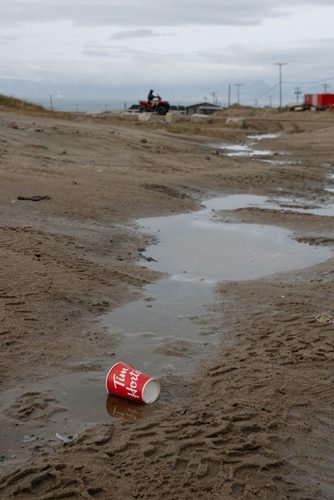
A discarded cup from the world’s northernmost Tim Hortons. In a region where permafrost and isolation complicate waste management, southern consumer habits often outpace the infrastructure built to contain them. Mittimatalik (Pond Inlet), Nunavut, Canada, 2024
Photography By Pamela EA
RESEARCH
Editing by Zohra Briki
January 29, 2026