
The term Conference of the Parties, better known through its acronym COP, is a term referring to the formal gathering of different state representatives (or “parties”) from all over the world to discuss a topic mandated by a Convention or treaty.
Originating with the Rio Convention in 1992, the most prominent COPs are the COP on climate change (organized by UN Framework Convention on Climate Change and hosted annually), the COP on biodiversity diversity (organized by the Convention on Biological Diversity and hosted every two years), and the COP to combat desertification (organized by the UN Convention to Combat Desertification every two years).
Over time, COPs have expanded far beyond diplomatic sessions. They have become meeting grounds for governments, scientists, activists, civil society, businesses, and multilateral organizations alike. This broader participation is structured through two distinct spaces:
The Blue Zone is the negotiation core of the COP. Accessible only through accreditation, it hosts formal talks between governments, official side events, pavilions, and authorized demonstrations. When someone mentions “attending COP”, they typically refer to the Blue Zone. This is where the agreements (or stalemates) that shape global policy emerge.
The Green Zone is the public-facing counterpart to the Blue Zone. Open with registration, it creates a bridge between the global political conversation and the host city’s communities, offering educational showcases and informal side events.
COPs play a crucial role in shaping the rules and setting goals for international policies related to their respective themes, having a significant impact on the economies worldwide. As global negotiation spaces, they also face political obstacles: conflicting interests, uneven representation between the Global North and the Global South in the attending civil society, lobbying, resource constraints, and language barriers. These tensions fuel longstanding criticisms of slow progress and structural inequities, yet COPs remain global forums of huge importance where the future of planetary governance is collectively debated.
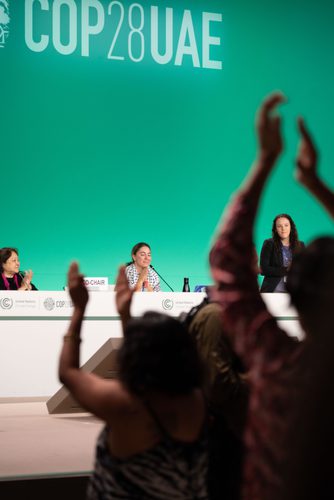
Delegates take part in the People’s Plenary, a forum for civil society, Indigenous groups, and activists to demand climate justice from world leaders, at the 28th session of the Conference of the Parties (COP28) to the UN Framework Convention on Climate Change (UNFCCC). Dubai, UAE, 2024.
Photography By Pamela EA
RESEARCH
Definition edited by Zohra Briki
Research by Micheala Chan
Fact-checking by Hailey Basiouny
Definition January 27, 2026
Research February 7, 2026
United Nations Climate Change. “How COPs are organized - Questions and answers” UNFCCC, n.d.
Robert McSweeney. “Analysis: How delegations at COP climate summits have changed over time” Carbon Brief, October 27, 2021.
RSPB. “COP16, COP29, CO – What-Now... What Is COP Anyway?” RSPB, October 17, 2024.
Charlotte Lock. “From Berlin to Baku: What has COP achieved?” Geographical, October 19, 2024.
Anne-Sophie Brändlin. “Climate Crisis: Why Do We Need COP Anyway?” Dw.com, October 20, 2021.
Diaz, Carlos Shanka Boissy, and Jodi-Ann Jue Xue Wang. “Another COP Failure: When Will There Be Justice for Marginalised Voices? - Institute of Development Studies.” Institute of Development Studies, December 2, 2024.
Mohammad Ibrahim Fheili. “Are Climate Summits Giving Legitimacy to Polluters? Rethinking COP!” Linkedin, November 18, 2024.
Dr Joanna Depledge. “Guest post: The challenge of consensus decision-making in UN climate negotiations”. Carbon Brief, March 5, 2024.
Global Focus. “Ensuring civil society’s vital role in global climate policy” Global Focus, 2023.
Stay Grounded. “The final declaration from Anti-COP 2024” Stay Grounded, November 19, 2024.